Japanese House Seamless Pattern: A Versatile Asset for Design and Cultural Projects
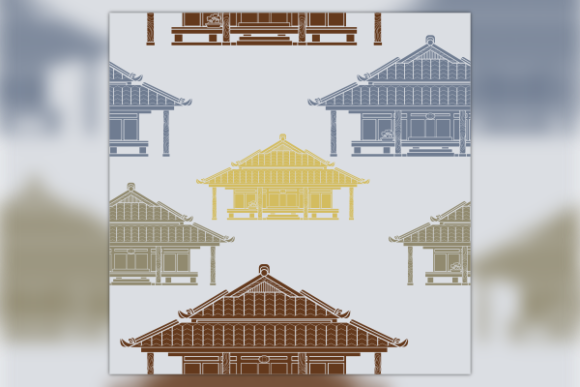
A Japanese House Seamless Pattern represents a specific intersection of traditional architecture and modern vector design. At its core, this asset is a flat monochrome illustration of a front-view traditional Japanese house, repeated infinitely to create a continuous background. Unlike standard raster images that lose quality when scaled, this pattern relies on editable SVG vectors, allowing designers to manipulate the geometry without pixelation. The distinct characteristic of this particular resource is its availability in various colors, transforming a simple architectural sketch into a dynamic textile or digital backdrop.
The utility of such a pattern extends far beyond simple decoration. It serves as a foundational element for creating backgrounds for fabrics, invitations, merchandise, and greeting cards. Furthermore, it acts as a critical decorative element for tourism travel campaigns and educational projects focused on historical or cultural topics. When evaluating this asset, one must consider not just the visual appeal but the technical flexibility it offers through software like Inkscape.
Distinguishing Features of the Flat Monochrome Style
The aesthetic of a Japanese House Seamless Pattern often diverges from photorealistic depictions of Japanese architecture. By utilizing a flat monochrome style, the design strips away shadows, gradients, and complex textures to focus on form and silhouette. This approach aligns with modern minimalism while retaining the iconic features of traditional homes, such as tiled roofs (kayabuki), wooden lattices, and sliding doors.
This stylistic choice offers several practical advantages over more detailed illustrations:
- Scalability: Because the image is vector-based, the lines remain crisp regardless of whether the pattern is printed on a business card or a large-scale banner.
- Versatility: The monochrome base allows for easy recoloring. Whether a project requires a stark black-and-white look or a vibrant palette, the underlying structure remains consistent.
- Clarity: In applications where text needs to be overlaid, such as on invitations or educational posters, a flat pattern provides a subtle texture without competing for visual attention.
However, this style does come with tradeoffs. If a project demands hyper-realism or an atmospheric depiction of a specific historical era, a flat vector illustration may feel too abstract. It is best suited for projects where the *idea* of the Japanese house is more important than a literal representation.
Evaluating Technical Formats and Editing Capabilities
When selecting a design asset, the file format is often the deciding factor. A high-quality Japanese House Seamless Pattern typically comes packaged in a ZIP file containing multiple formats: EPS, PDF, high-resolution PNG, and most importantly, the source SVG file. Understanding the differences between these formats is crucial for making an informed decision.
The SVG (Scalable Vector Graphics) format is the industry standard for web and print design because it is fully editable. While many users might rely on Adobe Illustrator, the prompt specifically highlights the use of Inkscape software. Inkscape is a powerful, open-source vector editor that handles SVG files natively. Using Inkscape to edit a Japanese House Seamless Pattern offers significant benefits:
- Cost Efficiency: It eliminates the need for expensive proprietary software licenses.
- Customization: Users can easily separate individual houses within the pattern, change stroke widths, or adjust color fills to match brand guidelines.
- Accessibility: The learning curve for Inkscape is manageable for beginners, yet it possesses advanced tools for path manipulation suitable for professional work.
In contrast, the included PNG files are rasterized versions. These are useful for quick previews or for users who do not have vector editing software. However, they cannot be resized without losing quality. The EPS and PDF files serve as universal interchange formats, ensuring compatibility with older printing presses or specific layout software that may not support SVG directly.
Comparison: Seamless Patterns vs. Single Illustrations
A common point of confusion for designers is choosing between a single, isolated illustration of a Japanese house and a seamless pattern. While both utilize similar source art, their application differs significantly.
If your goal is to feature a specific building as the focal point of a poster or a logo, a single illustration is superior. It commands attention and allows for detailed storytelling around that specific structure. Conversely, a Japanese House Seamless Pattern is designed to fill space. It creates a texture or a background field. It is ideal for wrapping paper, fabric swatches, or website backgrounds where the repetition itself adds to the aesthetic.
Consider the following scenarios:
- Scenario A: You are designing a brochure for a historical tour of Kyoto. You need a background that evokes the feeling of walking through a historic district without distracting from the text. A seamless pattern is the right choice here.
- Scenario B: You are creating a book cover about the architecture of a single famous temple. A single, high-detail illustration is better suited to highlight the unique features of that specific building.
Strategic Applications in Tourism and Education
The cultural significance of the Japanese house makes this pattern particularly valuable for tourism and educational materials. In the context of travel marketing, visuals must quickly convey a sense of place. A seamless pattern featuring traditional architecture instantly signals "Japan" to the viewer, bypassing the need for clichéd imagery like cherry blossoms or Mount Fuji.
For educational projects, the flat style is pedagogically effective. It simplifies complex architectural structures into understandable geometric shapes. Teachers can use the pattern to illustrate concepts of symmetry, roof pitch, or cultural heritage. When used in presentations or worksheets, the pattern provides a culturally relevant backdrop that enhances engagement without overwhelming the student with visual noise.
Merchandising also presents a strong use case. The repetitive nature of a seamless pattern makes it perfect for t-shirts, tote bags, and stationery. The ability to edit the colors via Inkscape allows businesses to create custom colorways for different seasons or target demographics. For instance, a winter collection might use cool blues and whites, while a spring collection could shift to soft pinks and greens, all derived from the same vector source.
Decision Factors and Potential Limitations
Before committing to a Japanese House Seamless Pattern, it is essential to weigh the limitations against the project requirements. While the asset is versatile, it is not a universal solution.
Limited Detail: As noted earlier, the flat monochrome style sacrifices detail. If a client requires intricate wood grain textures or specific regional architectural nuances (such as the difference between a farmhouse and a samurai residence), this generic pattern may be insufficient.
Software Dependency: While the package includes PNGs, the true value lies in the SVG file. If a team member lacks access to vector software like Inkscape or Illustrator, the potential of the asset is wasted. Relying solely on the provided PNGs limits the scope of the project to static images.
Cultural Context: Designers must ensure that the usage of the pattern respects the cultural context. While the image is a stylized representation, using it inappropriately—for example, in a context that trivializes traditional culture—can lead to negative reception. The pattern should be used to celebrate and educate rather than to appropriate.
Conclusion: Making the Right Choice
Selecting the right design asset involves balancing aesthetic goals with technical constraints. A Japanese House Seamless Pattern offers a robust solution for projects requiring a cohesive, scalable, and culturally resonant background. Its strength lies in its adaptability; the combination of flat monochrome art with editable vector paths allows for endless customization.
For professionals working with Inkscape, the inclusion of SVG, EPS, PDF, and high-resolution PNG files ensures that the workflow remains smooth from concept to final output. Whether the goal is to produce high-end textiles, engaging educational materials, or stylish merchandise, this pattern provides a solid foundation. However, if the project demands hyper-realism or focuses on a single architectural subject, alternative assets may be more appropriate.
Ultimately, the decision rests on the specific needs of the design brief. By understanding the strengths of the seamless format and the capabilities of the vector tools available, designers can leverage this resource to create compelling visual narratives that honor traditional aesthetics while meeting modern production standards.