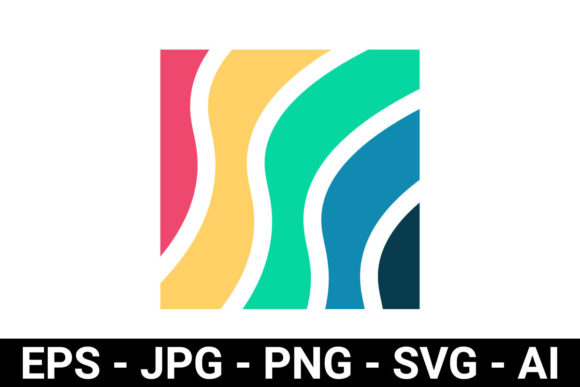
Colorful Wave Pattern for Background
When you are staring at a blank canvas or a fresh document, the hardest part is often just getting started. You need something that instantly sets a mood without overwhelming the viewer. This is where a colorful wave pattern for background becomes an essential tool in your creative arsenal. It isn't just about adding decoration; it is about establishing a visual rhythm that guides the eye and creates a sense of movement. Whether you are designing a flyer for a local community event, creating a digital banner for your blog, or simply looking to refresh your desktop wallpaper, these patterns offer a versatile solution that blends modern aesthetics with timeless appeal.
The concept behind this design element is rooted in simplicity and flow. Unlike rigid geometric grids or chaotic abstract splashes, waves suggest continuity and organic growth. They mimic the natural movement of water, wind, or sound, making them inherently calming yet dynamic. When you download a ZIP folder containing AI, EPS, SVG, JPG, and PNG versions of these patterns, you aren't just getting a single image; you are gaining a flexible resource that adapts to your specific workflow needs. From crisp vector lines suitable for large-scale printing to vibrant raster images perfect for web displays, the variety ensures you can maintain quality across every medium.
Why Modern Designers Love This Style
In today's fast-paced digital environment, users scroll through content in seconds. A static, flat color background often gets lost in the noise. A curved or striped wave pattern adds depth and texture without requiring complex 3D rendering or heavy file sizes. The beauty of this style lies in its ability to be both bold and subtle. You can use a high-contrast rainbow gradient to create excitement for a sale event, or opt for soft, pastel curves to provide a gentle backdrop for educational materials.
For freelancers and small business owners, time is money. Having access to a library of geometric wave designs means you don't have to spend hours sketching elements from scratch. These patterns serve as ready-made foundations. You can layer text over a flat illustration, place a logo within a curl, or use the ornament details to frame important information. The versatility allows you to pivot quickly between projects, ensuring your brand identity remains consistent even when your marketing channels change.
Real-World Applications Across Industries
The utility of a colorful wave pattern extends far beyond simple decoration. Let's look at how different professionals actually integrate these assets into their daily workflows.
- Marketing and Advertising: Imagine launching a new product line for summer. A digital banner featuring a bright, multicolor wave immediately evokes feelings of energy and freshness. Because the pattern is scalable, you can use the same design on a billboard, a social media story, and a printed brochure without losing resolution. The stripe and curve elements naturally lead the customer's eye toward the call-to-action button.
- Educational Content: Teachers and educators often struggle to make slides engaging for students. A decorative backdrop with soft waves can break up dense text and make learning materials feel less intimidating. For children's books or activity sheets, using origami-inspired or playful shapes within the wave structure makes the content feel interactive and fun. It transforms a standard lecture into a visually stimulating experience.
- Personal Branding and Blogging: If you run a lifestyle blog or a personal portfolio, your website needs to reflect your personality. A unique abstract wave pattern can serve as your site's signature header. Instead of a generic photo, a custom illustration based on these patterns shows creativity and attention to detail. It signals to visitors that you care about the user experience, not just the content itself.
- Event Planning and Invitations: Weddings, corporate galas, and birthday parties all require cohesive themes. A poster or cover design utilizing a sophisticated line wave pattern can convey elegance, while a colorful version screams celebration. The texture provided by these patterns adds a tactile quality to digital files, making them feel more premium when printed.
Navigating File Formats for Specific Needs
One of the most significant advantages of downloading a comprehensive package is having multiple file formats at your disposal. Understanding which format to use for which task is crucial for professional results.
If you are working on a project that requires resizing, such as a banner that needs to fit a mobile screen or a massive print display, the AI (Adobe Illustrator) and SVG (Scalable Vector Graphics) files are indispensable. These formats rely on mathematical equations rather than pixels, meaning you can zoom in infinitely without any loss of quality. This is particularly important for vector art used in logos or technical diagrams where sharp lines are non-negotiable.
Conversely, for web use, email newsletters, or quick social media posts, JPG and PNG files are often preferred. These formats are optimized for screen viewing and load faster. The PNG version is especially useful if you need transparency, allowing you to blend the wave pattern seamlessly over existing photos or colored sections. The EPS format serves as a universal bridge, ensuring compatibility across various design software suites, which is vital for collaborative projects involving teams who might use different tools.
Making the Right Choice for Your Project
Before applying a template or downloading a set, consider the context of your final output. Not every wave pattern fits every situation. A modern and graphic design with sharp angles and neon colors might work perfectly for a tech startup's landing page but could clash with the serene atmosphere of a wellness retreat. Conversely, a softer, simpler palette might feel too dull for a youth-oriented music festival poster.
Think about the message you want to convey. Do you want to communicate stability and flow, or do you need to evoke chaos and excitement? The concept of the wave is flexible enough to support both interpretations depending on the color choices and density of the lines. Pay attention to the element placement as well. Ensure there is enough negative space in the design to accommodate your text. A busy multicolor background can easily make white text unreadable if you don't adjust the contrast or add a semi-transparent overlay.
Also, consider the longevity of your design. Trends come and go, but the wave motif has remained relevant because of its organic nature. It feels timeless compared to some fleeting graphic styles. By choosing a creative and artistic approach that leans into the decoration aspect rather than trying to force it into a box, you ensure your work remains effective for years.
Integrating Patterns into Your Workflow
Once you have selected your ideal style, integrating it into your workflow should be seamless. Start by experimenting with opacity settings. Often, a wave pattern works best when it is faint, acting as a subtle texture rather than the main focus. This technique allows your primary content—whether it is a headline, an image, or a data chart—to take center stage while still benefiting from the visual interest of the background.
Don't limit yourself to just one pattern. Mixing different variations, such as combining a zigzag stripe with a smooth curve, can create a unique visual hierarchy. This approach is particularly effective in flyer design, where you need to guide the reader through different sections of information. Use the waves to separate distinct topics, creating a natural flow that mimics reading a story.
Ultimately, the value of a colorful wave pattern for background lies in its ability to solve problems before they arise. It saves you time, elevates your visual quality, and provides a reliable foundation for your creative ideas. Whether you are a seasoned graphic designer or a hobbyist crafting a birthday card, having these resources readily available empowers you to produce work that looks polished and professional. Embrace the flexibility of the shape and let the flow guide your next great design.